Director: Ben Palmer (2011)
Representation of
- Age
The four boys are represented as more normal than their parents. Jay and Simon's dads are quite innopropriate when talking about sex in front of the boys. Its a realistic representation of young boys as they are all going on a holiday abroad to meet girls and have a good time, which a lot of young boys do in the real world. Therefore, this allows other young boys to relate to the main characters.
- Ethnicity
All the people in the programme are white. You don't see people from other ethnicitys and as they are middle class it gives representations that most middle class people are white.
- Gender
The boys are represented as quite lazy and dependent on their mothers, seen as Simon doesn't help his mum with dinner and Will tells the audience how their parents have paid for their holiday. The females in the programme are quite objectified and the way in which the boys and men talk about the women is disrespectful. They are only seen as sexual objects. Audience being positioned to look at women from a males perspective to objectify females.
- Social class
All the people in the programme are represented as middle class from their level of education, they live in nice houses in the 'suburbs', which comes with it the stereotype of wealthy people. Simon also says the parents are paying for their holiday. Lower class people are not being targeted by the Inbetweeners as they will not identify with the middle class people in the film. The fact they go on holiday reflects they are middle class. If you are working class you have to stand on your own two feet more whereas the middle class don't have to rely on being independent. Types of cars they have. Their housing is safe and secure. Middle class parenting is represented to be much stronger and more traditional whereas working class representations show a lack of parenting.
Social class: Reinforcing cultural hegemony/ dominant ideologies
Working class British youths are generally represented as being violent, brutal, unapologetic, criminals, addictive personalities- Harry Brown, Eden Lake, Quadrophenia, Kidulthood
vs
Middle class british youths are generally represented as being more law abiding, conscientious citizens
On top of this the antagonists are always the working class youths and middle class adults are positioned to be the protagonists.
Fish Tank
Immeditately connotates their class and subculture by their clothes, colloquial language. Film is challenging dominant male representations because its a female protagonist. She is positioned as someone you need to identify with unlike Harry Brown where you are meant to identify with middle class. The style of film, use of handicam and lack of stylish camera work gives it a british feel and social realist edge.
Fish tank continues to represent young people in a similar 'broken britain' context but is more sympathetic to them.
The behaviour of the characters is less extreme- no torturing and general mayhem.
Most teenage characters in representations are working class whereas most adults are middle class. Youth representations are being filled by adults anxieties as Giroux's theory of an empty catorgory states.
Who produces these representations and why?
Media effects
Hypodermic model - Media injecting their theories into consumers, we as consumers have no power over how the media influences us. We are passive and believe everything we hear.
Cultivation theory - If you see enough violence, the more you see it the more you believe its actually happening and occuring in society at that level.
Copy Cat theory - So influenced by what you see, you copy what you're seeing. Jamie Bulger killing 'due to' copy cat theory.
Moral Panic - Media creates panic in society by setting the british youths to be antagonist, then the governement or police come as protagonists.
Analysis
Whose perspective is dominant in each of the texts?
What do the representations have in common?
How are the representations different?
How are the parental figures being represented?
How important is social class?
Social realist films attempt to portray issues facing ordinary people in their social situations.
Social realist films try to show that society and the capatalist system leads to the exploitation of the poor or dispossessed,
These groups are shown as victims of the system rather than being totally responsible for their own behaviour.
"These places represented everywhere of Britain where relationships are broken down and where people have become isolated and disconnected. Their britishness is their culturally specific address to audiences at home" (Murray, 2008)
These are directed at a British audience. In comparison to that films that are targeted at american audiences such as notting hill or love actually have more 'glossy' representations.
These films are made on a lower budget i.e fish tank, with handheld camera work.
When analysing representation, consider the following:
Who is being represented
Who is representing them?
How are they being represented?
What seems to be the intentions of the representations? Whats film trying to say?
What is the dominant discourse? ( World view offered by the film)
What range of readings are there?
Look for alternative discourses
Media contributes to our sense of 'collective identity'
Representations can cause problems for the groups being represented because marginalized groups have little control over their representation/ stereotyping
The social comtext in which the film/ tv programme is made influences the messages/ values/dominant discourse of the film.
Encoding- Decoding (stuart hall, 1980)
Encoding- Decoding is an active audience theory developed by stuart hall which examines the relationship between a text and its audience.
Encoding is the process by which text is constructed.
Decoding is the process by which the audience reads and understands and interprets.
Hall states that texts are polysemic, meaning they may be read differently by different people, depending on their identity, cultural knowledge and opinions.
Three ways
- Preferred reading- These representations are created to fufill hegemonic expectations so this is when an audience interpret the message that was meant to be understood. We understand the media text exactly how the industry wanted us to understand it - we agree with what we are seeing.
- Negotiated meaning- This contains a mixture of adapative and oppositional elements- you may not agree with everthing you see- you're going to acknowledge the dominant ideologies that are imbedded in the film. But there will be other elements in the film that you don't neccersarilly agree with.
- Oppostional reading/ counter hegemonic - You may understand the dominant ideologies but you disagree or refuse the media text completely.
Any representation is a mixture of:
1. The thing itself
2. The opinions of the people doing the representation
3. The reaction of the individual to the representation
4. The context of the society in which the representation is taking place
Stereotyping
We can identify with characters easily if there are stereotypes
Implicit personality theory
When you meet someone- you already make judgements
Past experience is more important than the actual personality we are judging
We have a system of rules that tell us which characteristics go where
We catogorise people into types (workaholic, feminist. etc)
These traits form a pattern of connections that can be called a prototype.
If we encounter someone in reality or in the media who seems to fit neatly into a prototype, we feel reassured. It confims our stereotyped view- we do not need to think further.
Once a few traits fit the prototype, we bundle the rest of the traits from the prototype onto the person.
If we find people who do not fit into our prototypes, we will form strong impressions of them, forces us to think more deeply.
We will try and twist the truth to make it fit into our prototype.. as time passes we forget these traits that do not fit in, this can lead to enormous differences bwteen our perceptions of people.
All of this happens naturally in our minds, its almost as if we conspire with the media to misunderstand the world.
Tuesday, 7 February 2012

Monday, 6 February 2012
Quadrophenia,(Frank Roddam 1979), set in 1965, depicts a representation of British youth after the second world war, when subcultures played a key role in forming youth identity. Contrast to this, Harry Brown (Daniel Barber 2009) reflects the attitudes in modern day society towards youth in Britain. However, similar themes and representations can be identified within the two texts.
Cohen's theory of moral panic can be applied to both Quadrophenia and Harry Brown. This theory suggests that a single group or person emerges out of the media to become defined as a threat to society and this creates moral panic. In the case of both these films, the youth have been defined as the threat to society as they are seen as engaging in acts of violence and threatening behaviour.
The theme of violence is heavily integrated within the two texts. In Quadrophenia, we see violence between the mods, rockers and the police. The riot scene gives a negative representation of the youth in Quadrophenia as they are portrayed as aggressive and rebellious. This theme of violence coincides with McRobbie's theory of symbolic violence which says that the middle class make sure the lower class are symbolised with violence in every media text which causes a boundary between the two classes and depicts the middle class as better. In Harry Brown, the youth also engage in aggressive and violent acts such as rioting whereas the police fall victim to these attacks, and therefore middle class is portrayed as better than lower class. Gerbner's cultivation theory , could also be applied, as it states the more violence we watch, the more we become used to it. In the case of Harry Brown, what Harry does in terms of going out and killing youths is accepted by us as we are used to the violence and therefore not shocked by it.
Class is an important theme that runs through out both texts. Strong binary oppositions between working class and middle class are present. In both films, the working class are represented as inferior whilst middle class is seen as superior. This complies to Gramsci's theory of cultural hegemony, as the middle class are trying to dominate society by making their way of life seem natural. This is exemplified in Harry Brown, where Harry is portrayed as being a "normal" elderly man, therefore depicting his way of life as the social norm and making the youth seem as though they are wrong as they don't follow the social norms that Harry does. Acland's Ideology of Protection, which states that middle and upper class believe society should be a certain way, could also be applied as Harry decides to take control of what he believes society should be like. In quadrophenia, it is the police who use their power of authority to try to control the youths and make them conform to societies norms.
There are similarities in the importance of gang ideologies in the two films. Although two seperate sub-cultures can be identified in both films, mods and rockers in Quadrophenia and chavs in Harry Brown, both films show the importance of subcultures to young people. Rebellion is a shared ideology in both youth subcultures in the two films. The 'mods' in Quadrophenia and the 'chavs' in Harry Brown like to rebel against society and any authority such as the police. Clothing , hoodies in Harry Brown, suits and thin ties, in Quadrophenia, is a key ideology of the two gang cultures and this shared sense in fashion is something that allows them to identify with eachother.
Identity and subcultures have a strong relationship in both films. In Quadrophenia, Jimmy only feels happy and accepted when with his 'mod' clique and this shows how the subculture has helped shape his identity. When his friends move on from the mod culture, Jimmy feels a loss of identity, not knowing where he belongs. Similar to this, the 'chav' youths seen in Harry Brown stay in a pack at all time, conveying that they identify with eachother and can't stand alone outside their subculture.
There is a difference within the role of parents in Harry Brown and Quadrophenia. In Harry Brown, it is clear that the character Noel has inherited his attitudes towards society from his parents, in particular his father who also spent time in prison. He has been inspired by his parents to rebel against authority whereas in Quadrophenia, Jimmy's hate for his parents has led him to join the mods and become rebellious. However in both cases, parents could be blamed for the way in which Jimmy and Noel turned out.
In conclusion, there are many similarities between the representation of youths in Quadrophenia and Harry Brown. Youths are depicted as trouble- makers who want to rebel against any kind of authority and overall they are represented negatively in both films.
Jack's Comments: A good essay here Sian Louisa Martin. Overall I think you have explained the points well, with using some relevant theory when needed.
16
17
8
40 TOTAL BAPBAPBAP
Cohen's theory of moral panic can be applied to both Quadrophenia and Harry Brown. This theory suggests that a single group or person emerges out of the media to become defined as a threat to society and this creates moral panic. In the case of both these films, the youth have been defined as the threat to society as they are seen as engaging in acts of violence and threatening behaviour.
The theme of violence is heavily integrated within the two texts. In Quadrophenia, we see violence between the mods, rockers and the police. The riot scene gives a negative representation of the youth in Quadrophenia as they are portrayed as aggressive and rebellious. This theme of violence coincides with McRobbie's theory of symbolic violence which says that the middle class make sure the lower class are symbolised with violence in every media text which causes a boundary between the two classes and depicts the middle class as better. In Harry Brown, the youth also engage in aggressive and violent acts such as rioting whereas the police fall victim to these attacks, and therefore middle class is portrayed as better than lower class. Gerbner's cultivation theory , could also be applied, as it states the more violence we watch, the more we become used to it. In the case of Harry Brown, what Harry does in terms of going out and killing youths is accepted by us as we are used to the violence and therefore not shocked by it.
Class is an important theme that runs through out both texts. Strong binary oppositions between working class and middle class are present. In both films, the working class are represented as inferior whilst middle class is seen as superior. This complies to Gramsci's theory of cultural hegemony, as the middle class are trying to dominate society by making their way of life seem natural. This is exemplified in Harry Brown, where Harry is portrayed as being a "normal" elderly man, therefore depicting his way of life as the social norm and making the youth seem as though they are wrong as they don't follow the social norms that Harry does. Acland's Ideology of Protection, which states that middle and upper class believe society should be a certain way, could also be applied as Harry decides to take control of what he believes society should be like. In quadrophenia, it is the police who use their power of authority to try to control the youths and make them conform to societies norms.
There are similarities in the importance of gang ideologies in the two films. Although two seperate sub-cultures can be identified in both films, mods and rockers in Quadrophenia and chavs in Harry Brown, both films show the importance of subcultures to young people. Rebellion is a shared ideology in both youth subcultures in the two films. The 'mods' in Quadrophenia and the 'chavs' in Harry Brown like to rebel against society and any authority such as the police. Clothing , hoodies in Harry Brown, suits and thin ties, in Quadrophenia, is a key ideology of the two gang cultures and this shared sense in fashion is something that allows them to identify with eachother.
Identity and subcultures have a strong relationship in both films. In Quadrophenia, Jimmy only feels happy and accepted when with his 'mod' clique and this shows how the subculture has helped shape his identity. When his friends move on from the mod culture, Jimmy feels a loss of identity, not knowing where he belongs. Similar to this, the 'chav' youths seen in Harry Brown stay in a pack at all time, conveying that they identify with eachother and can't stand alone outside their subculture.
There is a difference within the role of parents in Harry Brown and Quadrophenia. In Harry Brown, it is clear that the character Noel has inherited his attitudes towards society from his parents, in particular his father who also spent time in prison. He has been inspired by his parents to rebel against authority whereas in Quadrophenia, Jimmy's hate for his parents has led him to join the mods and become rebellious. However in both cases, parents could be blamed for the way in which Jimmy and Noel turned out.
In conclusion, there are many similarities between the representation of youths in Quadrophenia and Harry Brown. Youths are depicted as trouble- makers who want to rebel against any kind of authority and overall they are represented negatively in both films.
Jack's Comments: A good essay here Sian Louisa Martin. Overall I think you have explained the points well, with using some relevant theory when needed.
16
17
8
40 TOTAL BAPBAPBAP
Tuesday, 31 January 2012
This is england and quadrophenia


Describe the representation of youth in the two posters. What are the connotations of the two texts?
There are many similarities in the both of the film posters. Both youths in each poster appear to be individuals but are in a group as they all share the same fashion sense. The colours of the posters are very similar; both use british flag colours such as blue and red, which connotates that this is a highly British film. Both the youths in these photos are represented as confrontational by the way they are standing in a line all looking in the same direction. This makes both posters gritty and hard hitting.
However there are also differences between the two posters. The poster for This is England is much brighter and colourful, giving connotations that it is more modern. Whereas the poster for Quadrophenia is duller and resembles an old fashioned photograph therefore conveys it is a different time period to This is England. Although This is England uses reviews and a lot of text on the poster making it more appealing to go and see it as they are all very positive, Quadrophenia just has a title and a saying, making it appear less appealing to a reader.
The youths in the ‘This is England’ poster are represented as stereotypical skinheads by their shaven heads and the way they dress (cropped bomber jackets with tight jeans and high boots). This gives connotations that they may be violent as this is a common association with this subculture. The fact that there is only one black person in the poster also conveys that they may be racist as this is often associated with skinheads as well. The environment in this poster conveys that they are working class as they are stood against a run down wall and a council estate can be seen just behind the wall. The girls are well integrated within the group however they all appear to be striking less aggressive poses conveying that they are weaker than the boys. The use of one girl resting her head on the male also gives connotations that the girls are dependent on the boys for safety.
The youths from the ‘Quadrophenia’ poster appear to be from a different subculture. They look as if they are mods from their style including long coats, thin ties and stylish suits. The environment also connotates that they are from working class as they are stood against what appears to be a wooden fence. This is not very glamourous and therefore conveys they are quite common.
Thursday, 26 January 2012
How does contemporary representation compare to previous time periods?
What are the values of subculture?
Chavs
Brightly coloured sports clothing
Brands worn include Adidas Reebok Nike
Big dangly hooped earings
Low intelligence
Most are ill mannered
Think they're 'hard' but really not
Hang around in packs of 10 by fast food places
Teenage pregnancies
Go against society and cause anarchy
Values of subculture:
Or that adults can appear to conform for most of the working week, but re-enter the subculture at specific time (weekend, festivals etc.)
In 21st century the 'dominant meaning systems' (that define the mainstream) are crumbling.
"There is no mainstream now. There are many streams" Mainstream is in perpetual flux, rapaciously absorbing alternative culture as such a fast rate that the notion of a mainstream becomes obsolete.
So if there is no mainstream then there is nothing for the teens to react against- instead they are driven by other motives; and these must be understood on their own terms, individual terms.
1950's Teddies (teds/ teddy boys)

Introduction of Rock n Roll (bill haley and the comets)
"Kids heard the sound of Bill haley and were blown away by it- it provided kids with the tools to set themselves apart from the older generation"
1960's Mods
Uniform continuous revolved.
Bands such as the who and small faces had changed musical style and no longer considered themselves as mods.
They were getting into marriage had no time for youthful past times.

1960's Skinheads
Among working class youths, named for shaven heads. Greatly influenced from other subcultures such as west indian and british mods.
Attitudes by race and politics- Many are apolitical - Range from clean cut to less strict punk and hardcore influences.

Early 70's Punks
Cenetered around listening to recordings or live concerts of a loud, aggressive genre to rock music called punk rock.
Ideologies concerned with individual freedom. Anti- authoritarianism, non-conformity, direct action.
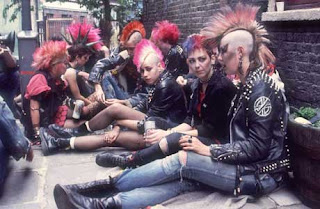
The cultural revolution 1950's and 60's
The war had just ended. With this came freedom and old social cultural structures began to be challenged, especially by the young.
- Rationing was coming to an end
- American way of life- key aspiration - Commercial TV
- Cheap colour magazines- luxary commodities
- World wide economic boom
- Labour was defeated by conservatives. Election slogan 'Set the people free'
- Youth given more freedom through deregulation
America and hollywood influenced Britain.
To the average Briton it offered a rich and desirable future.
Cultural imperialism- Cultural imperialism is the practice of promoting, distinguishing, separating, or artificially injecting the culture of on society into another.
Before people didnt have televisions, refrigerators, now they were seen as basic requirement.
Car ownership rose by 250% between 1951 and 1961- average weekly earnings rose by 34%.
Status and comfort.
Identity was based around design or fashion.
Teenagers demanded goods which would seperate them from adult.
Manufactures were happy to meet this demand, they offerered them products reflecting interest in fashion and pop music.
Higher education - helped to create an increase in social mobility
Establishment values began to be questioned
Affluence, social mobility and mass media had transformed British society.
General feeling of optimism but also a sense of uncertainty- society had become more fragmented and less predictable.
Chavs
Brightly coloured sports clothing
Brands worn include Adidas Reebok Nike
Big dangly hooped earings
Low intelligence
Most are ill mannered
Think they're 'hard' but really not
Hang around in packs of 10 by fast food places
Teenage pregnancies
Go against society and cause anarchy
Values of subculture:
- Conformity and rebellion
- Capitalism and consumerism
- 'Tribal' rivalry
- Traditional or 'neophile' (a person who loves novelty, one who likes trends; person who can accept the future enthusiastically and enjoys changes and evolution)
- Ideology in 1950s and 1960s- peace, rebellion against parents, radicalism- reactions against the post war
Or that adults can appear to conform for most of the working week, but re-enter the subculture at specific time (weekend, festivals etc.)
In 21st century the 'dominant meaning systems' (that define the mainstream) are crumbling.
"There is no mainstream now. There are many streams" Mainstream is in perpetual flux, rapaciously absorbing alternative culture as such a fast rate that the notion of a mainstream becomes obsolete.
So if there is no mainstream then there is nothing for the teens to react against- instead they are driven by other motives; and these must be understood on their own terms, individual terms.
1950's Teddies (teds/ teddy boys)

Introduction of Rock n Roll (bill haley and the comets)
"Kids heard the sound of Bill haley and were blown away by it- it provided kids with the tools to set themselves apart from the older generation"
1960's Mods
Uniform continuous revolved.
Bands such as the who and small faces had changed musical style and no longer considered themselves as mods.
They were getting into marriage had no time for youthful past times.
1960's Skinheads
Among working class youths, named for shaven heads. Greatly influenced from other subcultures such as west indian and british mods.
Attitudes by race and politics- Many are apolitical - Range from clean cut to less strict punk and hardcore influences.
Early 70's Punks
Cenetered around listening to recordings or live concerts of a loud, aggressive genre to rock music called punk rock.
Ideologies concerned with individual freedom. Anti- authoritarianism, non-conformity, direct action.

The cultural revolution 1950's and 60's
The war had just ended. With this came freedom and old social cultural structures began to be challenged, especially by the young.
- Rationing was coming to an end
- American way of life- key aspiration - Commercial TV
- Cheap colour magazines- luxary commodities
- World wide economic boom
- Labour was defeated by conservatives. Election slogan 'Set the people free'
- Youth given more freedom through deregulation
America and hollywood influenced Britain.
To the average Briton it offered a rich and desirable future.
Cultural imperialism- Cultural imperialism is the practice of promoting, distinguishing, separating, or artificially injecting the culture of on society into another.
Before people didnt have televisions, refrigerators, now they were seen as basic requirement.
Car ownership rose by 250% between 1951 and 1961- average weekly earnings rose by 34%.
Status and comfort.
Identity was based around design or fashion.
Teenagers demanded goods which would seperate them from adult.
Manufactures were happy to meet this demand, they offerered them products reflecting interest in fashion and pop music.
Higher education - helped to create an increase in social mobility
Establishment values began to be questioned
Affluence, social mobility and mass media had transformed British society.
General feeling of optimism but also a sense of uncertainty- society had become more fragmented and less predictable.
Tuesday, 17 January 2012
How do the contemporary media represent British youth and youth culture in different ways?
Harry Brown 2009 Director: Daniel Barber
How does Harry Brown represent young people?
Iconography and Themes:
use of hoodies- creates ideas in our heads on what to expect
dogs
knifes, guns
activities
drugs
location- subway
objectifies women
female police officer challenges gender stereotype- however is ignored by fellow male co-workers
territory
revenge
friendship
diologue- colloquial language
Three way binary oppositions between Harry, the gangs and the police
Old vs young
Social class - Gangs - lower class - Police- middle class
Low key lighting- dark characters, builds suspense, lots of shadows
Genre- crime thriller with some horror
Hoodies strike fear in British Cinema
It suggests young people are represented as dehuminsed thugs without emotions. Seen as monsters (zombies, vampires)
This links to the horror genre, the less you know about something the more you are scared of it. Teens are now the monsters however they are real, and this makes them very scary.
In terms of social class, Council estates like 'prison cells', very claustrophobic, can't escape from anyone. Dont have a future, survival is harder so they turn to aggression and drugs.
Refers to right wing politics
Hegemony- the power of the ruling class, they want us to believe a particular thing about a certain class such as lower class. Make clear distinctions between classes. Creating these distinctions through the media.
For example, ASBO's were introduced by the media.
Moral panic- make us fear stuff
Implications of the representations
Eden Lake Director: James Watkins
How are Jenny and Steve the main couple represented?
How is this contrasted with the representation of the other characters?
How important is the issue of social class?
How are young people represented?
At the beginning the dialogue from Jenny makes her appear quite ungrateful and spoilt as she mocks the fact that Steve is taking her on a trip to a 'rundown quary'. However Jenny and Steve are represented as a nice loving couple by the way they interact with eachother, such as laughing in the car together and kiss in the lake. They appear to be middle class by the car they drive and their nice clothes. The bright, warm lighting at the beginning of the trailer as it follows the couple, give connotations that they are kind happy people.
In contrast to this, the youths who they encounter on their holiday are represented as monsters. The first time Steve talks to the youths, he approaches them calmy and asks them to turn their music down, which represents him as reasonable. However, in response, they are aggressive and the female youth is rude as she trys to imply that Steve was looking at her breasts. The youths are also represented negatively as they are seen driving around in Jenny and Steve's car.
In the next part of the trailer, the representation of the youths turns extremly negative as there are shots of them torturing Jenny and Steve, making them seem like monsters. The lighting under the mise-en-scene becomes low key lighting conveying that there is a very dark side to the youths and expressing Jenny and Steve's vunerability as they are less likely to see the youths if its dark, giving the youths an advantage.
The clothing and dialogue of the youths make them seem lower class and therefore this trailer shows binary oppositions of lower class vs middle class.
As the couple are there on their holiday, this highlights the fact that the youths have nothing better to do and also shows that this is their territory and therefore gives them an advantage over the couple as they know the woods better.
The youths are conveyed as a pack of animals as they outnumber the couple, and the use of their rotweiller gives them more of an adavantage.
The use of nightime when the danger occurs in the trailer.
As steve is seen injured and Jenny left to find help, this trailer represents women as vuneralble and shows the men being violent rather then the women.
The location of the woods makes the couple seem isolated from the rest of the world and highlights their vunerability.
Introduced to equilibrium- disruption to equilibrium- equilbrium is restored.
Attack the Block (2011) Director- Joe Cornish
At the beginning, the youths are represented as monsters as they are creeping around in the shadows, and attacking the women. The iconography represents them as typical youths withs hoods and bandanas to cover their identity when mugging someone. Oppotunistic crime as she is crossing into their territory.
Their colloquial language makes them appear as a pack and hard to understand therefore hard to predict.
How does Harry Brown represent young people?
Iconography and Themes:
use of hoodies- creates ideas in our heads on what to expect
dogs
knifes, guns
activities
drugs
location- subway
objectifies women
female police officer challenges gender stereotype- however is ignored by fellow male co-workers
territory
revenge
friendship
diologue- colloquial language
Three way binary oppositions between Harry, the gangs and the police
Old vs young
Social class - Gangs - lower class - Police- middle class
Low key lighting- dark characters, builds suspense, lots of shadows
Genre- crime thriller with some horror
Hoodies strike fear in British Cinema
It suggests young people are represented as dehuminsed thugs without emotions. Seen as monsters (zombies, vampires)
This links to the horror genre, the less you know about something the more you are scared of it. Teens are now the monsters however they are real, and this makes them very scary.
In terms of social class, Council estates like 'prison cells', very claustrophobic, can't escape from anyone. Dont have a future, survival is harder so they turn to aggression and drugs.
Refers to right wing politics
Hegemony- the power of the ruling class, they want us to believe a particular thing about a certain class such as lower class. Make clear distinctions between classes. Creating these distinctions through the media.
For example, ASBO's were introduced by the media.
Moral panic- make us fear stuff
Implications of the representations
Eden Lake Director: James Watkins
How are Jenny and Steve the main couple represented?
How is this contrasted with the representation of the other characters?
How important is the issue of social class?
How are young people represented?
At the beginning the dialogue from Jenny makes her appear quite ungrateful and spoilt as she mocks the fact that Steve is taking her on a trip to a 'rundown quary'. However Jenny and Steve are represented as a nice loving couple by the way they interact with eachother, such as laughing in the car together and kiss in the lake. They appear to be middle class by the car they drive and their nice clothes. The bright, warm lighting at the beginning of the trailer as it follows the couple, give connotations that they are kind happy people.
In contrast to this, the youths who they encounter on their holiday are represented as monsters. The first time Steve talks to the youths, he approaches them calmy and asks them to turn their music down, which represents him as reasonable. However, in response, they are aggressive and the female youth is rude as she trys to imply that Steve was looking at her breasts. The youths are also represented negatively as they are seen driving around in Jenny and Steve's car.
In the next part of the trailer, the representation of the youths turns extremly negative as there are shots of them torturing Jenny and Steve, making them seem like monsters. The lighting under the mise-en-scene becomes low key lighting conveying that there is a very dark side to the youths and expressing Jenny and Steve's vunerability as they are less likely to see the youths if its dark, giving the youths an advantage.
The clothing and dialogue of the youths make them seem lower class and therefore this trailer shows binary oppositions of lower class vs middle class.
As the couple are there on their holiday, this highlights the fact that the youths have nothing better to do and also shows that this is their territory and therefore gives them an advantage over the couple as they know the woods better.
The youths are conveyed as a pack of animals as they outnumber the couple, and the use of their rotweiller gives them more of an adavantage.
The use of nightime when the danger occurs in the trailer.
As steve is seen injured and Jenny left to find help, this trailer represents women as vuneralble and shows the men being violent rather then the women.
The location of the woods makes the couple seem isolated from the rest of the world and highlights their vunerability.
- Horror film is normality is threatened by the monster.
- Dominant ideologies- conformity to the dominant social norms
- Youths are not conforming to dominant ideologies, in the past this has been the skinheads, mods, rockers, hippies.
Introduced to equilibrium- disruption to equilibrium- equilbrium is restored.
Attack the Block (2011) Director- Joe Cornish
At the beginning, the youths are represented as monsters as they are creeping around in the shadows, and attacking the women. The iconography represents them as typical youths withs hoods and bandanas to cover their identity when mugging someone. Oppotunistic crime as she is crossing into their territory.
Their colloquial language makes them appear as a pack and hard to understand therefore hard to predict.
Friday, 13 January 2012
Harry Brown (2009)
Director: Daniel Barber
- How are youths being represented?
- How are the audience being positioned? (to identify with the characters)
- What is the significance of social class?
- How are youths being represented?
- How are the audience being positioned? (to identify with the characters)
- What is the significance of social class?
Thursday, 12 January 2012
Exam outline
Examination is two hours.
Section A: Theoretical evaluation of production (50 marks)
1a) Theoretical evaluation of skill development over the course of the two years (both AS and A2 c/w productions including preliminary and ancillary tasks) (30 mins)
Describe and evaluate skill development and the question will require them to adapt this to one or two specific production practises. The list of practices to which questions relate is as follows:
- Digital Technology
- Creativity
- Research and Planning
- Post- production
- Using conventions from real media texts
Examiners don't know what you've done so you can tell porky pies. But do not come up with huge lies eg. manipulating a photo more than you did.
1b) Theoretical evaluation of one production and evaluate it in relation to a media concept (30 mins)
This requires candidates to select one production and evaluate it in relation to a media concept. The list of concepts to which questions relate is as follows:
- Genre
- Narrative
- Representation
- Audience
- Media language
Section B: Contemporary Media Isssues (50 marks)
2) Contemporary Media Issues- Media and collective Identity- The representation of British youth and youth culture (1 hour)
2007 onwards as it is contemporary.
In order to fully prepared for the specific requirements of the question, the material studied by candidates must cover these three elements:
Section A: Theoretical evaluation of production (50 marks)
1a) Theoretical evaluation of skill development over the course of the two years (both AS and A2 c/w productions including preliminary and ancillary tasks) (30 mins)
Describe and evaluate skill development and the question will require them to adapt this to one or two specific production practises. The list of practices to which questions relate is as follows:
- Digital Technology
- Creativity
- Research and Planning
- Post- production
- Using conventions from real media texts
Examiners don't know what you've done so you can tell porky pies. But do not come up with huge lies eg. manipulating a photo more than you did.
1b) Theoretical evaluation of one production and evaluate it in relation to a media concept (30 mins)
This requires candidates to select one production and evaluate it in relation to a media concept. The list of concepts to which questions relate is as follows:
- Genre
- Narrative
- Representation
- Audience
- Media language
Section B: Contemporary Media Isssues (50 marks)
2) Contemporary Media Issues- Media and collective Identity- The representation of British youth and youth culture (1 hour)
2007 onwards as it is contemporary.
- How do the contemporary media represent British Youth and Youth culture in different ways?
- How does contemporary representation compare to previous time periods?
- What are the social implications of different media representations of British Youth and youth culture?
- To what extent is human identity increasingly 'mediated'?
In order to fully prepared for the specific requirements of the question, the material studied by candidates must cover these three elements:
- -Historical- dependent on the requirements of the topic, candidates must summarise the development of the media forms in question in theoretical contexts.
- Contemporary- examples from five years before the examination.
- Future- Candidates must demonstrate personal engagement with debates about the future of the media forms/ issues that the topic relates to.
Subscribe to:
Posts (Atom)